Rallying

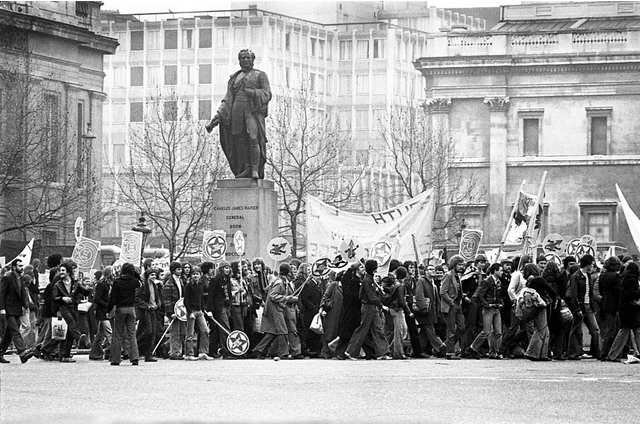
In April 1978, at the Rock Against Racism concert in Victoria Park, The Clash played their song “English Civil War” live for the first time. The organization Rock Against Racism, formed in 1976 in reaction to racist incidents and the rise of the National Front in the UK as well as to racist statements by Eric Clapton and David Bowie, staged two national carnivals in 1978, the first in Victoria Park in East London, where The Clash played with Steel Pulse, a reggae band from Birmingham, and a few other punk bands.

“English Civil War” is set to the tune of “When Johnny Comes Marching Home,” the American Civil War ballad, and also borrows its first line. The song uses this inspiration to imagine the war it fears is, as Joe Strummer said in an interview shortly after the song’s first performance, “right around the corner.” I thought of the song yesterday, after watching clips from Trump’s Madison Square Garden rally the night before, and played it couple of times. I’m playing it right now.

The line that made me think of this song yesterday: “Your face was blue in the light of the screen/As we watched the speech of an animal scream.” As has been the case for nine years, I’m angry at Trump and his mob’s racist, hateful rhetoric almost as much as I am at what he’s done in office, at what he’s inspired in others in other offices, and at what he threatens to do if he gets into the White House again. I’m angry at this rhetoric not only because of the immediate effects on its objects and the potential acts of violence it can inspire but because of the long-term effects on us. Our faces are lit by our screens a thousand times more than they were in 1978, everywhere we go, walking and driving and laying in bed; these days, we get to hear animal screams like we heard a couple of nights ago everywhere and all the time. If you’re the immediate object of the hatred, of the racist attacks on your intelligence and humanity, the hurt must go very deep. If you’re not but don’t agree with what they yell and don’t want to live in a world where it’s okay to yell those things, that’s another kind of hurt, also profound. But what if you don’t know to be hurt, don’t know that it’s not okay to yell those things? What if you’ve grown up in the last nine years hearing them? What if you’ve seen people cheering them on and repeating them?

What I didn’t remember until I listened again to “English Civil War” is how the song ends:

When Johnny comes marching home again
Nobody understands it can happen again
The sun is shining and the kids are shouting loud
But you gotta know it’s shining through a crack in the cloud
And the shadows keep on falling when Johnny comes marching home

The balancing of hope and fear in these lines capture what all the young punks (to quote a different song) involved in Rock Against Racism must have been feeling almost fifty years ago as they heard the boots of the National Front crunching around the corner and the spittle-flecked slurs fly from Eric Clapton’s lips. They hoped that calling it all out, together, shouting loud, would have some effect, but at the same time they feared that it wouldn’t be enough, that the sun squeezing through the crack in the clouds would lose out to the falling, looming shadows. That it could happen again.

Fifty years later and a week out from election day, millions of Americans know the feeling. But millions of us don’t–they’re cheering on the animal scream. And fifty years from now, the kids whose faces were blue from the light of the screens showing them these rallies, these speeches, this hate: what about them?

& & &

“English Civil War” was released as a single in February 1979. The b-side was a cover of the Toots and the Maytals song, “Pressure Drop.” The Clash had already covered a Junior Murvin song, “Police and Thieves,” on their first album, demonstrating their affinity for reggae music and for its incorporation of political sentiment (though it may not have always been appreciated– Murvin’s initial response to the cover was reportedly “They have destroyed Jah work!”). Toots Hibbert has said that “Pressure Drop” is a song about karma, about bad things happening to people who do bad things to innocent people–“pressure’s going to drop on you”–and that he wrote it after he had been innocently imprisoned. It may be a revenge song, but it’s not about violence, at least not explicitly; instead, it’s about the knowledge coming to the malefactor–“I say when it drops, oh you gonna feel it/Know that you were doing wrong.”

So I’ll end my early evening in the office listening to this song instead. It’s not a happy song, exactly, though it’s less unhappy than “English Civil War.” But the hope that people doing wrong will know that they were doing it, someday–or at least and maybe even better, that the millions watching will know, someday, that what they heard those people saying and saw them doing were wrong–is not nothing.


Sure It Can

For the last nine years, people have been saying what’s been known about our last president since he was in second grade and gave his music teacher a black eye (or lied later to his ghostwriter about having done so, I don’t know which is worse, but either way he was a confirmed menace): he has the instincts of a bully. He conducts himself like one in his business career and personal life and, when he had the chance, tried to run the country like one.

“Bully” is not exactly “fascist,” but it’s not really far off: a fascist is a bully the people of a country foolishly allow to be in charge of it. For the last nine years some very educated people have argued that he’s not one. Now that there is no more quiet part, he’s straight out telling us he is. And the other objection–not that he doesn’t have fascist instincts but that he’s just inept–never held water, and really won’t now. Last time, there were people around him to stop him from doing the worst. Because we’ve allowed him to run again and because the court he built has taken away the legal guardrails, if he wins, by hook or more likely by crook (nobody actually knows the origin of that phrase, so I can use it however I want), he will be able to do what he’s always wanted, for his rich friends and to everyone else. And millions of us will cheer him on until we feel the boot on our necks too rather than just on those of the neighbors we’d mocked and hated along with him.

And if he doesn’t win the election–and the institutions stand and our nerve holds so that he can’t steal it–we have to do everything we can to change things so we never find ourselves here again. We have to figure out how to show ourselves what he is and what we’re cheering for. And we have to build new and better guardrails. We’re close enough to it happening here to know, finally, that it can.

Driving Meaningful Engagements: On AI, ET, and TU

Ever feel like you’re being sold a bill of goods?

Excerpts from two emails that landed in my inbox yesterday:

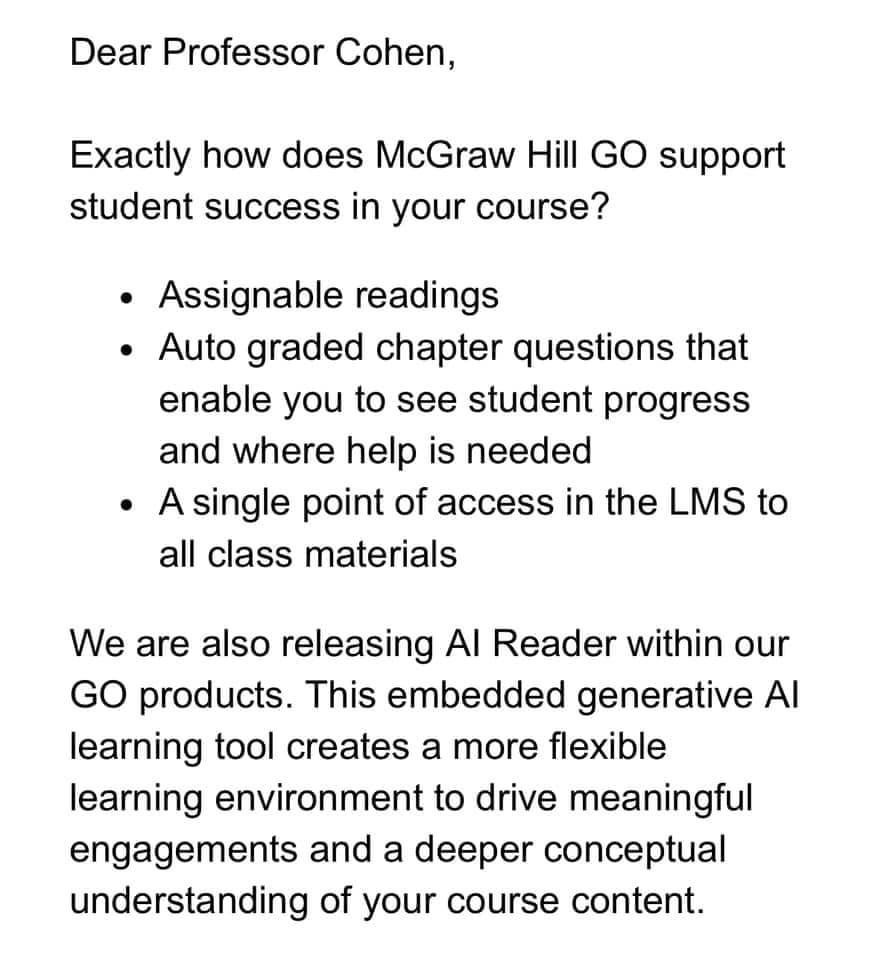
The first is from an email helpfully sent to me by McGraw Hill GO, which as the name shouts, is raring to GO to sell me a product that will help me teach, ostensibly. I mean look!

It’s an eBook+! It lives within my LMS! It makes it easier to keep up with student progress and direct attention where it matters most, which is apparently somewhere other than whether my students are learning! I guess I should be grateful for that assurance of knowing my students are completing the reading, but instead I’m checking to see if I still have my wallet. Can I drive this eBook+ off the lot right now?

It’s the AI that I should apparently be most grateful for, though. The embedded generative AI learning tool, I am told, will create a more flexible learning environment! And that environment will drive meaningful engagements! It will also drive a deeper conceptual understanding, as opposed to some other kind of understanding, of my course content! So much driving! So much cause and effect! Instead of the hard and messy work of trying to help my students understand the things they read, the world around them, and themselves and their place in it, all I have to do is sit back and let GO drive. Whew. What a relief.

The second email comes from the Teaching for Learning (?) Center at my employer, This University in Canada, You’ve Never Heard of It. A featured speaker at an upcoming event will be the AI expert whose identity I have tried to disguise for some reason. This person will be coming to This University (TU, go fight win) to share with us the Good News of AI, sharing the εὐαγγέλιον, the gospel, that artificial intelligence has risen and will be our salvation. Do you believe in the Good News? It believes in you!

It’s the end of a long and cranky week, so forgive me the sarcasm. I’m not here to impugn motives of publishers, staff, or administrators or to criticize fellow instructors for wanting a break from the difficult work of teaching. I’m sensitive to the privilege I am lucky to enjoy of working at a research-intensive university, where, if I want, on a Friday afternoon during under-attended office hours, I can take a half hour and blog my thoughts into the abyss, and I’m sensitive to the four-four or more load of many instructors, for whom in my textbooks I have selected readings (and written apparatus supporting them) in order to lessen that load.

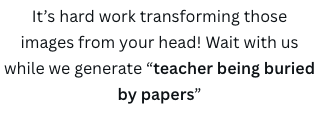
My first ever AI generated images
(prompt: “teacher being buried by papers”)

What I’m doing here with this spare half hour is saying that these claims of AI’s salvific power makes me feel like I’m being sold a bill of goods. The educational publishing company is in the business of selling things to help educators, and can hardly be faulted. It’s what it does. It has to keep swimming or it dies, or something. The whole world of ed tech (ET, by decree and henceforth) is in the same business. TU and by extension higher education are most emphatically not in the same business as EdTechpreneurs, and should not be the gullible rubes who snap up its latest products. Universities have been busy establishing a sorry track record of diving headfirst into the latest ET innovations–remember MOOCs?–and moving on from them once their promise went unrealized, leaving behind a trail littered with spent money and damaged morale.

I don’t want to overstate. I wouldn’t be so rash as to condemn everything about LMSes (how do you pluralize an acronym that ends in S? Why are my office hours today so quiet? Does it have anything to do with it being homecoming weekend?). As we learned during the pandemic, they make some things easier. But they can’t be used to replace us.

Thanks, Google™

There is considerable pressure on higher ed administrators to cut costs, and as anybody who’s looked at university finances knows, one of the only places they can cut is instructor pay and benefits. It’s why you see departments shrinking as retired tenured faculty go unreplaced; it’s why you see whole departments razed if administrators can’t wait patiently for faculty to die off or at least go away. Contingent laborers cost less. ET promises lower costs. Humanities instruction, at least, what I do, is labor intensive. Human labor intensive. Humanities departments are forever being berated for the high costs of small classes (discussions which seem never to touch on the rarely mentioned high overhead incurred by the research grants given the big-lecture-teaching faculty in other disciplines, but that’s another discussion). The value of what we do lies in helping students learn to think, creatively and critically. We want to help them learn to be able to process large amounts of complicated information, to grapple with sophisticated concepts, to know when they’re being sold a bill of goods.

Thanks, Canva™

I don’t want resource-gobbling AI to transform the images in my head. I want to do it myself because part of the reward of creative thought and expression lies in the doing of it. I want my students to learn this. I don’t want TU or any other institution of higher learning to try to save money by outsourcing the work of education; in the end it will waste both the money it spends and the opportunity for students to learn to want to come up with interpretations, solutions, expressions. I got my first AI generated assignment this week. I read it. I knew instantly where it came from, and it was confirmed by an abashed student, and it sucked. It didn’t know anything, and it didn’t think anything, and it didn’t express anything.

My office hours are over. Monday morning I’ll come back to campus. At noon, my students and I will discuss the upsetting ending of Toni Morrison’s upsetting and beautiful novel The Bluest Eye, and we will talk about the history of it being banned around the country and in the town some of them come from by people who don’t value the kind of education that involves reading upsetting and beautiful things, and we will probably also talk about homecoming weekend and think about what universities are for, which I am always trying to get them to do because the whole point is to get them to look around and think about where they are, whether “there” is their classroom or university or state or country or planet. (They will also get good paying jobs because they know how to read and think and express their thoughts but can we please not let that be the only reason we do this?) I will try to drive meaningful engagements, if you want to put it that way, and appreciate the opportunity I have been given to do this important work the way I think most effective. Also I use much less water.