For the last nine years, people have been saying what’s been known about our last president since he was in second grade and gave his music teacher a black eye (or lied later to his ghostwriter about having done so, I don’t know which is worse, but either way he was a confirmed menace): he has the instincts of a bully. He conducts himself like one in his business career and personal life and, when he had the chance, tried to run the country like one.
“Bully” is not exactly “fascist,” but it’s not really far off: a fascist is a bully the people of a country foolishly allow to be in charge of it. For the last nine years some very educated people have argued that he’s not one. Now that there is no more quiet part, he’s straight out telling us he is. And the other objection–not that he doesn’t have fascist instincts but that he’s just inept–never held water, and really won’t now. Last time, there were people around him to stop him from doing the worst. Because we’ve allowed him to run again and because the court he built has taken away the legal guardrails, if he wins, by hook or more likely by crook (nobody actually knows the origin of that phrase, so I can use it however I want), he will be able to do what he’s always wanted, for his rich friends and to everyone else. And millions of us will cheer him on until we feel the boot on our necks too rather than just on those of the neighbors we’d mocked and hated along with him.
And if he doesn’t win the election–and the institutions stand and our nerve holds so that he can’t steal it–we have to do everything we can to change things so we never find ourselves here again. We have to figure out how to show ourselves what he is and what we’re cheering for. And we have to build new and better guardrails. We’re close enough to it happening here to know, finally, that it can.
Excerpts from two emails that landed in my inbox yesterday:
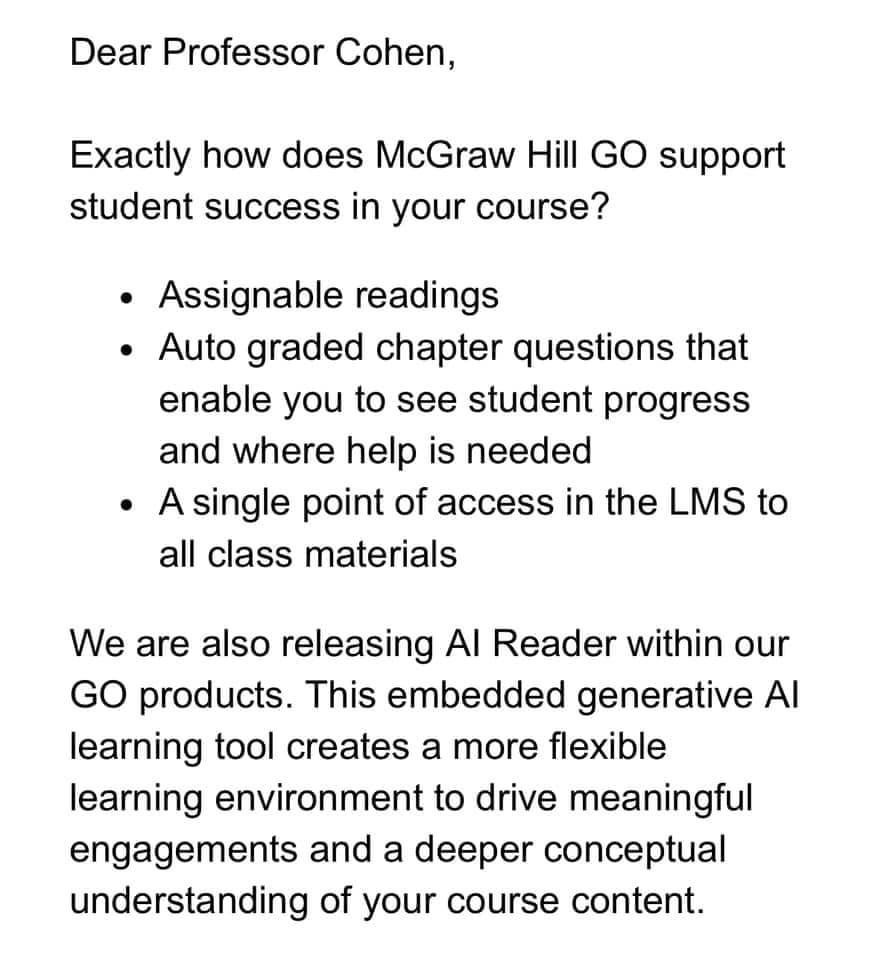
The first is from an email helpfully sent to me by McGraw Hill GO, which as the name shouts, is raring to GO to sell me a product that will help me teach, ostensibly. I mean look!
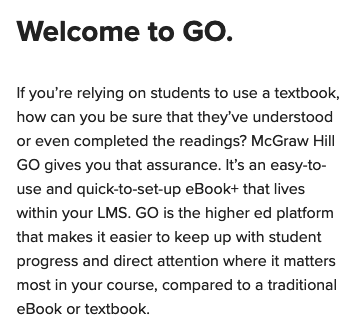
It’s an eBook+! It lives within my LMS! It makes it easier to keep up with student progress and direct attention where it matters most, which is apparently somewhere other than whether my students are learning! I guess I should be grateful for that assurance of knowing my students are completing the reading, but instead I’m checking to see if I still have my wallet. Can I drive this eBook+ off the lot right now?
It’s the AI that I should apparently be most grateful for, though. The embedded generative AI learning tool, I am told, will create a more flexible learning environment! And that environment will drive meaningful engagements! It will also drive a deeper conceptual understanding, as opposed to some other kind of understanding, of my course content! So much driving! So much cause and effect! Instead of the hard and messy work of trying to help my students understand the things they read, the world around them, and themselves and their place in it, all I have to do is sit back and let GO drive. Whew. What a relief.
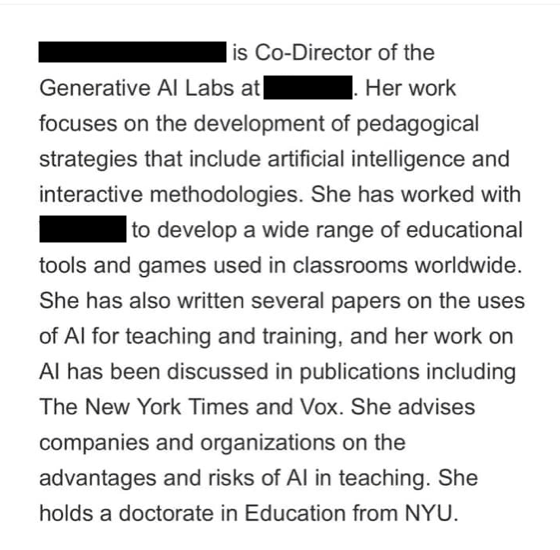
The second email comes from the Teaching for Learning (?) Center at my employer, This University in Canada, You’ve Never Heard of It. A featured speaker at an upcoming event will be the AI expert whose identity I have tried to disguise for some reason. This person will be coming to This University (TU, go fight win) to share with us the Good News of AI, sharing the εὐαγγέλιον, the gospel, that artificial intelligence has risen and will be our salvation. Do you believe in the Good News? It believes in you!
It’s the end of a long and cranky week, so forgive me the sarcasm. I’m not here to impugn motives of publishers, staff, or administrators or to criticize fellow instructors for wanting a break from the difficult work of teaching. I’m sensitive to the privilege I am lucky to enjoy of working at a research-intensive university, where, if I want, on a Friday afternoon during under-attended office hours, I can take a half hour and blog my thoughts into the abyss, and I’m sensitive to the four-four or more load of many instructors, for whom in my textbooks I have selected readings (and written apparatus supporting them) in order to lessen that load.
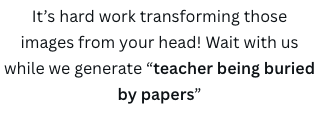
My first ever AI generated images (prompt: “teacher being buried by papers”)
What I’m doing here with this spare half hour is saying that these claims of AI’s salvific power makes me feel like I’m being sold a bill of goods. The educational publishing company is in the business of selling things to help educators, and can hardly be faulted. It’s what it does. It has to keep swimming or it dies, or something. The whole world of ed tech (ET, by decree and henceforth) is in the same business. TU and by extension higher education are most emphatically not in the same business as EdTechpreneurs, and should not be the gullible rubes who snap up its latest products. Universities have been busy establishing a sorry track record of diving headfirst into the latest ET innovations–remember MOOCs?–and moving on from them once their promise went unrealized, leaving behind a trail littered with spent money and damaged morale.
I don’t want to overstate. I wouldn’t be so rash as to condemn everything about LMSes (how do you pluralize an acronym that ends in S? Why are my office hours today so quiet? Does it have anything to do with it being homecoming weekend?). As we learned during the pandemic, they make some things easier. But they can’t be used to replace us.
Thanks, Google™
There is considerable pressure on higher ed administrators to cut costs, and as anybody who’s looked at university finances knows, one of the only places they can cut is instructor pay and benefits. It’s why you see departments shrinking as retired tenured faculty go unreplaced; it’s why you see whole departments razed if administrators can’t wait patiently for faculty to die off or at least go away. Contingent laborers cost less. ET promises lower costs. Humanities instruction, at least, what I do, is labor intensive. Human labor intensive. Humanities departments are forever being berated for the high costs of small classes (discussions which seem never to touch on the rarely mentioned high overhead incurred by the research grants given the big-lecture-teaching faculty in other disciplines, but that’s another discussion). The value of what we do lies in helping students learn to think, creatively and critically. We want to help them learn to be able to process large amounts of complicated information, to grapple with sophisticated concepts, to know when they’re being sold a bill of goods.
Thanks, Canva™
I don’t want resource-gobbling AI to transform the images in my head. I want to do it myself because part of the reward of creative thought and expression lies in the doing of it. I want my students to learn this. I don’t want TU or any other institution of higher learning to try to save money by outsourcing the work of education; in the end it will waste both the money it spends and the opportunity for students to learn to want to come up with interpretations, solutions, expressions. I got my first AI generated assignment this week. I read it. I knew instantly where it came from, and it was confirmed by an abashed student, and it sucked. It didn’t know anything, and it didn’t think anything, and it didn’t express anything.
My office hours are over. Monday morning I’ll come back to campus. At noon, my students and I will discuss the upsetting ending of Toni Morrison’s upsetting and beautiful novel The Bluest Eye, and we will talk about the history of it being banned around the country and in the town some of them come from by people who don’t value the kind of education that involves reading upsetting and beautiful things, and we will probably also talk about homecoming weekend and think about what universities are for, which I am always trying to get them to do because the whole point is to get them to look around and think about where they are, whether “there” is their classroom or university or state or country or planet. (They will also get good paying jobs because they know how to read and think and express their thoughts but can we please not let that be the only reason we do this?) I will try to drive meaningful engagements, if you want to put it that way, and appreciate the opportunity I have been given to do this important work the way I think most effective. Also I use much less water.
Today I taught my first class of the new school year. It was the first meeting of my course on book banning in America, and, as I learned when I asked them to go around the room and introduce themselves by saying where they were from and what their major was, what their favorite book is, students are taking the class for various reasons: because they liked the topic, because they needed to fulfill a distribution requirement, because they were in my class last semester and didn’t hate me I guess.
I had a great time.
Of course this is not the most important thing about a class meeting. It might be the least important thing, though I think many of us teach better when we’re enjoying ourselves. But it felt good to be in a room with thirty students on the first day of a semester, introducing what we’ll be working on for the next fifteen weeks. We came together, for fifty minutes, to earn distribution credits and for other reasons, starting to get to know each other a little and to think together about the history of attempts by Americans to keep other Americans from reading books they decided they shouldn’t get to read. It felt like possibility, as it has the first day of every semester I’ve taught for thirty years (!). And the way the summer’s gone, nationally, possibility feels especially good to me right now.
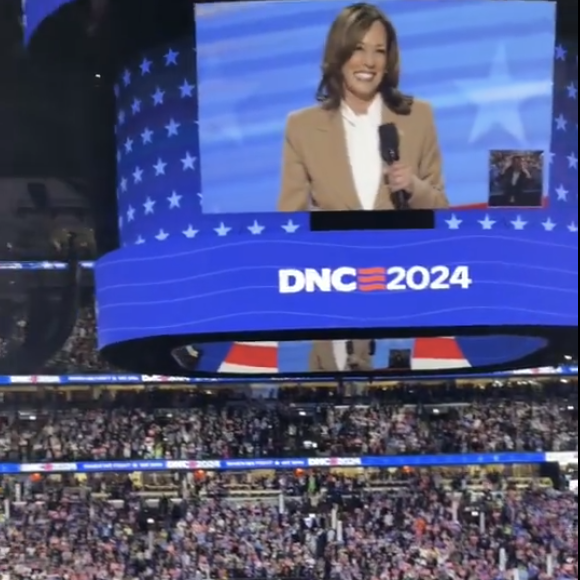
Tonight I’m sitting in front of the TV watching the Democratic National Convention. It’s easy to be cynical about conventions–there’s no more theatrical political theater–but so far this one is pretty inspiring. UAW President Shawn Fain followed Warriors coach Steve Kerr. A smart producer cut from Alexandria Ocasio Cortez delivering a fiery speech to a shot of Jesse Jackson listening and looking impressed. I’m feeling demographically targeted. I’m also feeling something like what I felt this morning. A convention is a coming together, etymologically. And it’s about possibility, about what the people coming together can make happen. And this particular convention comes at a time when that possibility feels pretty precious.
Wednesday, when class meets again, we’ll be talking about the long history of book banning in the world and the shorter but very busy history of book banning in the US. One event I’ll bring to the discussion is the banning of Thomas Morton’s 1637 New English Canaan. Morton came to Massachusetts in 1624 with the Puritans to Plymouth Colony, established an offshoot community that traded with Native Americans, and got exiled for it. New English Canaan is a celebration of the culture of the natives and a criticism of their treatment at the hands of the Puritans. So they banned it, making it likely the first book explicitly banned in what is now the United States. Importantly for our purposes in the course, the banning was motivated by fear—fear of loss of business from Plymouth to the natives, and fear of the natives themselves, with whom Governor William Bradford saw Morton’s people “dancing and frisking together,” something not even allowed among themselves. By the time we get to contemporary efforts to keep books away from children, we’ll draw the parallels to the motivating fear of difference–of Black people, queer people, people who don’t conform, who resist–behind those efforts.
As with the topic of my course, there’s a long history behind what’s happening this week in Chicago. It’s not always pretty, that history, not the part that began before the Puritans and not the part that began when Barack Obama made a joke that Donald Trump didn’t like. When things have improved over the course of that history, it’s been because people came together to work toward the possibility of treating others, however defined, better.
Jasmine Crockett, a former public defender and Democratic representative from Texas, is speaking now. Again, it’s easy to be cynical, but come on. Maybe we’re coming together. Maybe it’s working.
So I was playing pickleball this morning here in sunny Columbia, MO and thought a guy playing on the other court was Lucas Kunce. Lucas Kunce is running for US Senate against one of the top five worst men in the world, Josh Hawley, and seems like a decent guy. He’s from Jefferson City, a half hour south. I stood next to him once at a fundraiser while he talked to my wife about gun policy. His policy positions jibe with my preferences and values and with reality. Most important, he’s not Josh Hawley, but so is the ham sandwich I would vote for before Hawley.
Sen. Josh Hawley (R-MO) speaking at NatCon: ⁰⁰"Some will say now that I am calling America a Christian nation. So I am. And some will say that I am advocating Christian nationalism. And so I do." pic.twitter.com/ja09ThFlyM
— Heartland Signal (@HeartlandSignal) July 9, 2024
At any rate, it wasn’t Lucas Kunce. I knew it couldn’t be him because what would he be doing playing pickleball on a Sunday morning in the heat of campaign season and he didn’t seem tall enough. Then when he and the man he was playing with needed people and I was sitting out over at my game, I went over and played with him and confirmed that he really wasn’t Lucas Kunce, and told him that from a distance he kind of looked like he was. His response was to say no and say he just moved here and to ask if that’s how people pronounce Kunce.
I hope it was.
I tell this fairly boring story because I was excited to meet Lucas Kunce, which means I was excited to meet someone running for national office from Missouri, which means I think that I must believe he has a chance to win. Polls says he does, and while I don’t trust polls much, I do believe that he’s an appealing candidate (even John Goodman says so) who’s got good comms people and some fight in him and that Trump’s increasing inability to not seem like an unbalanced malignant narcissist will prove to be a down-ballot drag and that Missouri has never been as red as it’s recently seemed, gerrymandering and all. Like Trump, Hawley has the ability to convince the current GOP base that he’s on their side, but the rest of Missouri might not be buying what he’s selling.
If you’re not from here, or from another red state, you might not understand how remarkable it feels to be excited to meet a candidate for national office from your state who might actually win. If you haven’t endured years of being represented by people who believe that all you need for a good political ad (other than bigotry and xenophobia) is blowing things up, or shooting them, or lighting them on fire, you might not sense the weight of this moment for us.
I want to see a debate among the 21 Missouri Republican Senate candidates. It would work like the Hunger Games, where Eric Greitens brings his gun, Eric Schmitt brings his flamethrower, etc. Now THAT would be a debate worth watching! pic.twitter.com/TlpMAEgJzn
— Democracy on the Move (@allonthemove) July 7, 2022
This morning’s non-encounter brought the moment home to me. Sure, I’m filled with dread like always, as the GOP isn’t even trying to hide their attempts at ratfuckery, but the sinking feeling of just a month ago, when Biden had not yet stepped down from the campaign, is gone, and now I have to admit that to myself, and not just in terms of the presidential election. If Missourians give money and knock doors and turn out, we could have people in office from our state who give a shit about it for a change. Democrats from Missouri for a long time had to be careful not to stray too far left, and recently that’s not been enough. But it’s possible that neither is the case any more; a certain kind of left populism seems to be having a moment and the momentum driven by defense of abortion rights may finally prove too much for the Gerrymandering Old Party, here and across the country, meaning Democrats can be Democrats here and win.
Missouri voters will decide in November whether to guarantee a right to abortion with a constitutional amendment that would reverse the state’s near-total ban on the procedure. https://t.co/IqyLVl3Vff
I’m nearing the end of Ed Park’s fantastic (as in very good but also as in not realist) novel Same Bed Different Dreams, flying too fast through its meticulously constructed pages, trying to remember who’s who and what’s real and to figure out how things are connected in its highly researched, deeply imagined account of Korean and American history. I can’t recommend it highly enough.
At one point, the novel tells the story of a fake thing that really happened in Buffalo, NY in 1952. Responding to a request by the military, the editor of the Buffalo Evening News publishes an edition of the paper reporting that the city’s downtown had been hit by a Soviet atomic bomb. The idea, the lieutenant general who makes the request tells the editor, is not to do another War of the Worlds but to make the public remember what their military shields them from, as it fights for them in Korea. In the editor’s words, “They will imagine the ruins of the city.” The paper even includes an explanation of how they were able to publish that details the destruction, down to the loss of their building: “Buffalo Evening News employes [sic] reported for work this morning as usual–a few hours later all were killed or wounded.”
Reading this part of the novel this morning, I had the ridiculous thought that my local paper would do this. Tomorrow. I would wake up, walk down my front walk, pick up the paper, take it out of the blue plastic bag, and see the headlines: TRUMP ADMINISTRATION ORCHESTRATES COUP, INSTITUTES MARTIAL LAW. PROVISIONAL GOVERNMENT BEGINS MASS DEPORTATIONS, OPENS CAMPS FOR INTERNAL ENEMIES.
I imagined this ridiculous prank because I’ve been not-watching the Republican National Convention and because I’ve been living in the U.S. for the last eight years and forty-nine before that. I imagined it because I’ve been hearing on social media what they’ve been saying in Milwaukee and joked this morning that it might be time to teach Sinclair Lewis’ novel It Can’t Happen Here again.
I want somebody to remind my fellow citizens of what our democracy–as compromised and undemocratic and unequal as it’s been for many of us and as harmful as our behavior has often been abroad–exists to shield us from, to borrow the editor’s words, what the institutions and people of good faith who try to hold them up work to keep at bay: the authoritarians and kleptocrats, the true believers, the people who hold up Trump as their savior, protected from flying teleprompter glass by god, protecting them from taxation and regulation. Instead of describing how civilized the Republican convention has been or how riven by disagreement the Democrats are (or instead of reporting on the convention’s lies or the incumbent’s actual health and electoral chances, but who are we kidding), it might be good to have the newspapers scare the shit out of us by showing us an imagined future where what could happen does.
Want to say it couldn’t happen? Want to Corey Robin this and tell us Trump’s not a fascist because he’s incompetent or because you want to look smart? Want to tell me that you know best about the coming election because departments of political science exist and use numbers to tell us things that sometimes numbers can’t tell us? Go for it, but don’t come crying to me when what can’t happen here happens here because you thought you knew better.
I don’t know how Same Bed Different Dreams ends. But I feel like I’m in good hands, like Ed Park understands the power of history and storytelling and the responsibility he’s taken on in constructing his own imaginative history. I don’t know how the story of this election ends either, but I don’t feel like I’m in good hands with American journalism anymore, largely. I don’t even feel that way anymore about many of my peers–friends, colleagues, professors across the country, fellow voters–and that’s an awful feeling (one many of them feel about me, I’m sure). It’s time to stop fucking around. It’s time to imagine the ruins of the city and use those imagined ruins not to be paralyzed by anxiety or depression or moved to rash decisions or infighting but to keep the ruins from becoming reality, or at least any realer than the foot soldiers in state legislatures, school boards, and high courts are already working to make them. In the words of Fountains of Wayne, it’s time to get our shit together.
But to my friends who say What’s to celebrate, this country’s been racist and sexist and horrible to the people indigenous to this land we’re supposed to be celebrating the independence of for ever and ever amen, it’s all in the Constitution that the Supreme Court just tore into bits, I say Of course, all true, now what?
Nationalism’s almost as bad as religion for making people kill each other, everybody knows this (read what our friend Mark Twain had to say about it). But a nation is what we live in, and as unhappy as it makes us day to day, with its obscene levels of gun death and incarceration and economic, gender, and racial inequality, this one was set up from its founding to allow (some) people to try to make it better, fairer, more equal. How’s it doing? Not great. But better than it was!
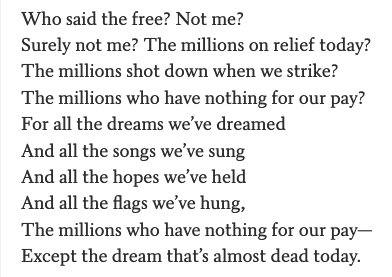
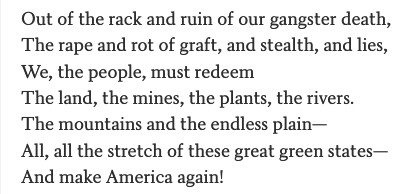
So you won’t catch me watching a parade or wearing red, white, and blue or blowing shit up, but I won’t criticize people who do those things if they do them in ways that say Yay, America, let’s keep working on this jawn, rather than We’re #1 except we’re a hellscape because of all of these migrants/gays/liberals, &c., so let’s get rid of them. Tomorrow I will grill hot dogs and drink something and see if I can renew our passports online or if I have to mail them in, no reason in particular, nothing to see here, move along. And I will read this Langston Hughes poem like I do every year (like I read Philip Levine on Labor Day, because I’m a simple soul), because it says this:
And because it says this:
So Happy 4th to all who celebrate in order not to fall into the deepest despair, which, given the last week or so, is easy to do, I’m told.
Referring to the then-current forms of government in the colonies, the Declaration of Independence, 248 years old on Thursday, says it is a time “when a long train of abuses and usurpations, pursuing invariably the same Object evinces a design to reduce them under absolute Despotism.” It goes on to lay this at the feet of George III: “The history of the present King of Great Britain is a history of repeated injuries and usurpations, all having in direct object the establishment of an absolute Tyranny over these States.”
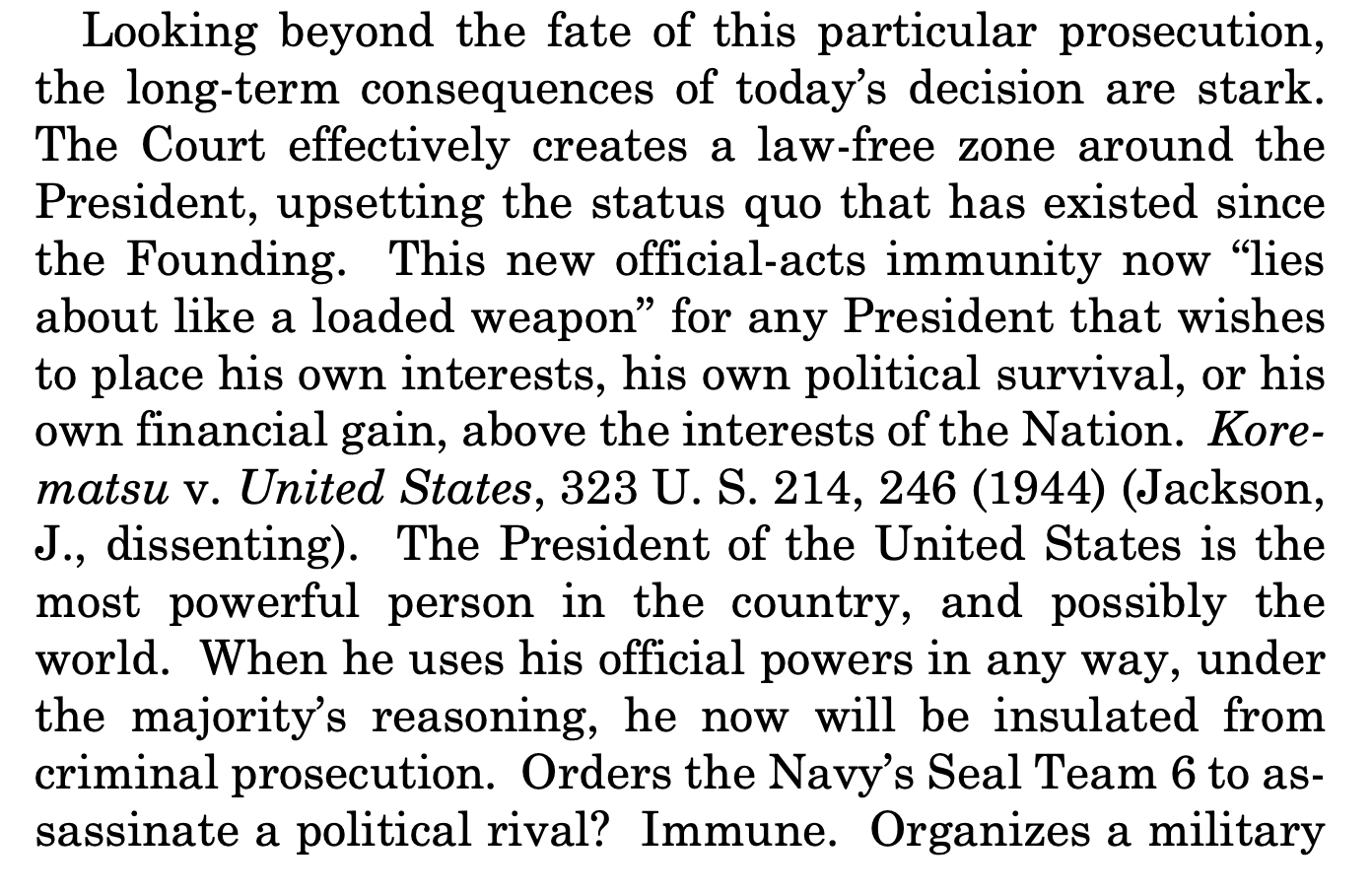
And here we are, today, July 1, 2024, with a new King-in-waiting, courtesy of a deeply compromised Supreme Court (“compromised” is a nice way to say a range of things from ideologically extreme to intellectually bankrupt to bought and paid for, and I am saying all of them). A King who could sit at the head of a government that recent Supreme Court decisions have turned on its head, giving to courts the power to hobble the federal agencies that do the crucial work of protecting us from corporate greed. Abuses and usurpations. You might even say absolute tyranny.
Justice Sotomayor’s dissent makes this plain:
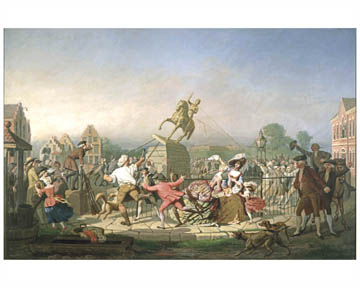
After a public reading of the Declaration upon its approval by the Second Continental Congress, a statue of George on horseback at Bowling Green was pulled down. The story is that 40,000 musket balls were made out of it (so it goes). William Walcutt painted the scene of its destruction in 1857, and apparently was only one of many artists drawn to the incident from the nation’s founding at a time when the Union seemed in peril of pulling itself apart.
It managed to survive, the nation. So far anyway. Who’s to say if it will survive this.
While the New York Times, the Pod Save America guys, and your friends on social media freak out about the debate, don’t forget to freak out about Friday morning’s SCOTUS decision, in which the bought members of the court took a Missouri GOP statewide office campaign spot-style flamethrower to the Deep State, or the entire institutional structure of how things actually get done to keep the country from food and waterborne illness, environmental destruction, and Other Things Rich People Don’t Want Getting in the Way of More Riches. I have some thoughts about the debate, the Democratic reaction to which has been understandable but completely out of hand and somewhere outside the confines of what a Bush Sr official once called the reality-based community, and they include a call to maybe focus a little bit on the man at the other podium lying to our faces.
They also include focusing on the damage that has just been done, damage the Leo/Koch/Bannon/Stone/Moloch right wants to continue to do to the boring, troublesome offices and officials that have until now worked to keep corporations from trampling the entire country underfoot. Half the country thinks The Other Guy and the armies of flunkies and toadies eager to be seen supporting him and eager to pursue the same cynical populism are in this for them, and a big chunk of them will feel the brunt of the effects an effectively deregulated economy will have outside of gated communities (and, eventually inside them, of course, but who can think that far ahead, am I right?). Maybe they’ll be surprised.
You want Freedom? How about the freedom to breathe clean air, drink clean water, and eat clean food? Sorry but this decision, brought to you by the few very rich white men who bought the deciders, makes that a lot less likely. The government hasn’t actually gotten smaller, as these people have always said they wanted, but it certainly won’t be able to help much. As Reagan put it a long time ago, “The nine most terrifying words in the English language are: I’m from the Government, and I’m here to help. “
I’ve been thinking this morning of something that happened nearly twenty years ago, and I’m trying to figure out why. It has something to do with the presidential debate that took place last night, which I had the good sense to almost entirely miss but caught enough of, and read enough about, to be disturbed. What that connection is is what I’m trying to figure out.
In 2006 I gave a talk at a conference on 9/11 at McMaster University in Hamilton, Ontario. Before the conference, I’d seen the names of a well-known pair of 9/11 Truthers on the online program and emailed the organizers to ask that my name be removed from it so that I wouldn’t be associated with their brand of “found the one engineer in the entire world who will argue that Jet fuel doesn’t burn hot enough to bring down a skyscraper, plus nobody saw the plane hit the Pentagon, so 9/11 was an inside job” conspiracy theorizing. I had no plans to call them out at the conference until one of them (I’m not naming them because, honestly, fuck them) approached the microphone at a lunchtime open forum/general meeting to share the good word of 9/11 Trutherism, which was met by Canadian politeness, American apathy, and maybe some agreement, I don’t know.
I stepped up to the microphone and addressed myself to the graduate students in the room while ignoring the man who’d just spoken. I said some things about how there was plenty of reason for suspicion of the American government, including the failure of the Bush administration to heed intelligence warnings about such an attack, but that giving time and attention to people like the man who just spoke is a bad idea, as trying to approach the truth with intellectual integrity is a big part of the business we were in. I sat down vibrating with an anger that came not just from an abstract defense of intellectual values but also from my experience of living in downtown Manhattan in September 2001, trekking home from work in the Bronx when the trains started to shut down, emerging to see military vehicles in the middle of 42nd Street, running from hospital to hospital looking for my brother-in-law, who worked in the towers and was not to be found, seeing and smelling the Towers’ smoke from my apartment window for weeks. After I sat down, I was thanked by a few people and ignored by the subjects of my remarks, as I expected.
Reliving this memory at my desk eighteen years later, my body is telling me that the feeling of wanting to confront people who say untrue things is the connection between this remembered moment and last night. While a lot of the chatter this morning is from rightfully anxious people on the left responding to Biden’s performance by saying he needs to let someone else run, what I’m sitting with right now is the feeling of having someone lie to your face. Whether the liar in this kind of situation knows that they’re lies or has convinced himself that they’re true may be of interest, but it’s less important in the end than the fact that he’s saying them as if they’re trueand that nobody is saying anything. This isn’t an intellectual realization for me, and I suspect for many–it’s a feeling in your chest. It’s like that feeling you had when you were a kid and somebody cheated in a game, or stole your toy, or said something you knew wasn’t true and nobody challenged them. It’s the feeling that something obviously wrong is happening and that people are letting it happen. It makes you wonder if people care or if the world is a place where wrong things just happen.
Fifty-seven-year-old me knows that the world is a place where wrong things just happen, but he also believes that it is also a place where something can sometimes be done about them if people pay attention to them, if people point them out, call out their wrongness, ask others to notice and address the wrong things. Many of us believe this. What we think is wrong, and right, is what divides us, and arguments over what’s right and what’s wrong are what politics is. But it’s also people who don’t seem to care about right and wrong and just want to be in charge. We’ve all known those people since we were kids. Standing up to them, to the kids who did wrong things and didn’t care because they wanted to be in charge–we called them bullies then and should do so now–can make you unpopular. It doesn’t make you feel better. But you do it out of self-defense and you do it because someone has to or the world is only a place where wrong things happen.
I understand that people are anxious, and they absolutely have a right to be, about the health of the president and about the danger of his opponent winning in November. But what I’m feeling this morning is the wrongness of Trump’s lies, as baldfaced as they’ve ever been, things that everybody knows arelies. And I’m wishing people would talk about that, would stand up to the bully who lied to us last night and to all the second-tier bullies in his gang, standing next to him on the playground, defending his lies. Otherwise what kind of world is this?
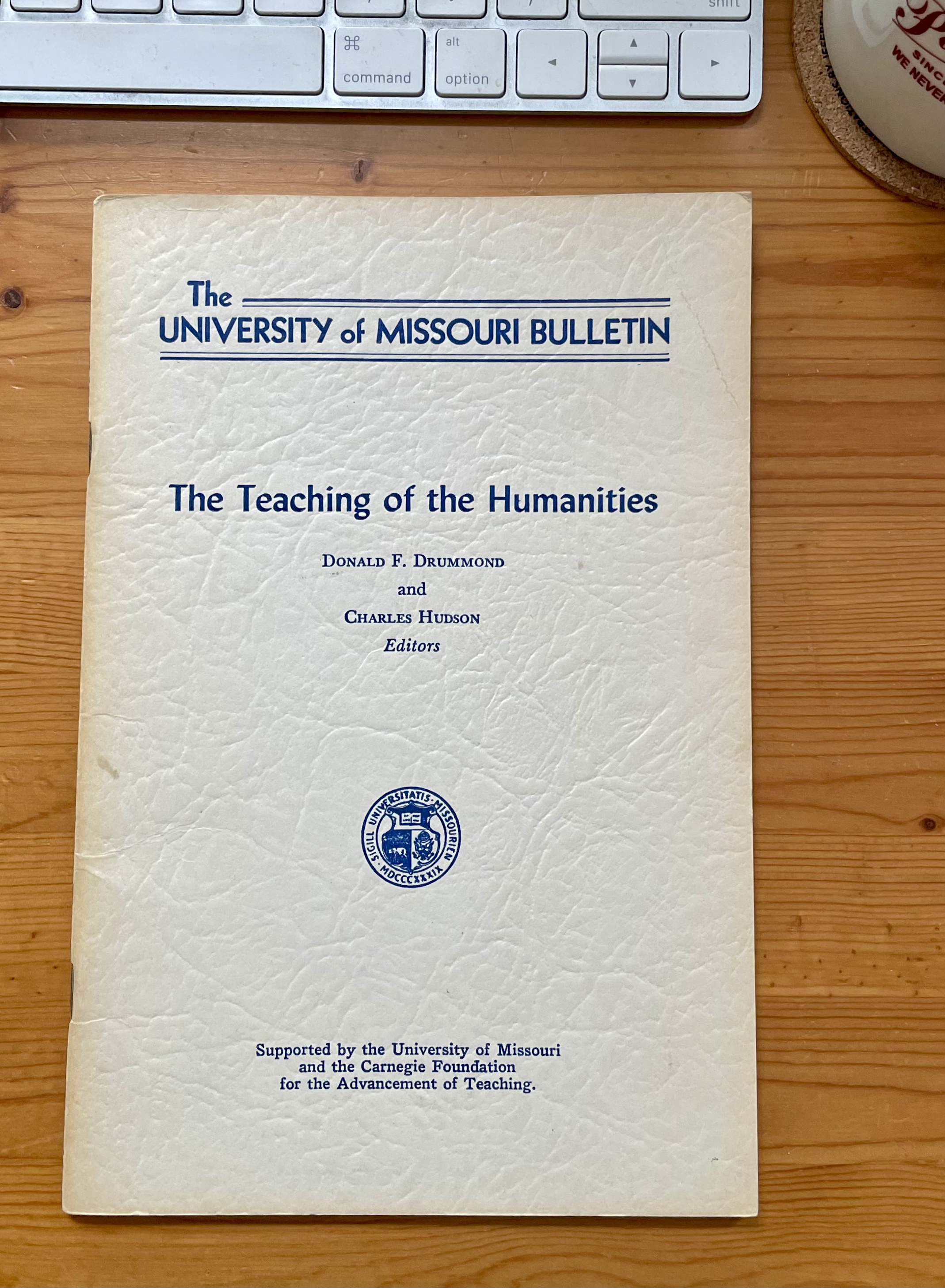
I found this report at an estate sale a while ago. It was published seventy years ago by the University of Missouri (where I may or may not work, who’s to say). It’s a report from a three-year series of conferences on humanities teaching funded by the university and by the Carnegie Foundation for the Advancement of Teaching.
In the back, there’s an appendix written by Professor Charles Hudson of the University of Missouri English Department. It’s about a new course in “general humanities” that he’d been developing with a colleague. They’d spent a year traveling the country, studying humanities programs at other universities. In the appendix, he lays out his rationale for the course.
The above is part of his rationale for teaching in the “humanistic disciplines.” It is a very mid-1950s statement, from the default male pronoun to the talk of values and a “philosophy of life.” As the passage itself says of this last phrase, though, its triteness should not blind us to its importance. Further, this importance, it insists, must be understood as being about, in his words, not a ready-made system of values but rather free and enlightened choice among values.
Today there were two developments in the long, ongoing war on the humanities, and they made me think of that war in the light of this report. The first development was Chris Rufo, Mark Bauerlein, and the rest of the trustees Ron DeSantis put in charge of New College voting to shutter their gender studies program. Rufo tweeted:
Incoherence aside (Rufo is not a strong writer or thinker, and that second sentence is especially good evidence), this tweet is an example of what Professor Hudson warned against seventy years ago: thinking that the humanities are about teaching a ready-made system of values. The board’s express aim of turning New College into another Hillsdale College, one that it has pursued ruthlessly, firing Pat Okker, the college president, and pushing scores of faculty to the exits, has nothing to do with a free and enlightened choice of values.
Today’s other development happened at West Virginia University, which looks like it’s being stripped for parts under serial school-colored bowtie adopter Gordon Gee, ostensibly to deal with a financial crisis. It was reported today that the Department of World Languages is being recommended for closing, with all programs being shut down and total reduction of faculty. This development is an example of another front in the war on the humanities. I cannot remember, among all the announcements of closures and reductions in recent years, there being any mention of STEM departments and programs. Foreign language departments are threatened routinely, usually under the logic that they can’t support themselves, a logic that only appears to make sense in a non-profit institution that as a matter of course subsidizes all kinds of activities and programs its stewards decide are worthy.
To decide that the study of foreign languages is not important enough to support is to decide that the humanities don’t matter. To decide that gender studies has no place in higher education is to decide that the values that the humanities disciplines consider shouldn’t be chosen freely but rather that the institution, in some cases the state, should choose them ahead of time. Whatever these people think universities are for–to provide culture war battlegrounds or neckwear color schemes–the result of their decisions is that it is harder for their schools to produce graduates who can think critically about values. It’s hard not to think that what those who make these decisions really want is to reduce the chances that their schools might produce broadly educated future employees, voters, parents, citizens, people who can choose their values for themselves. As the man who is somehow still the leader of Rufo’s party once said he loves the poorly educated, so do the people in charge of these schools seem to love the unfreely, uncuriously, narrowly educated. The philosophy of life that Professor Hudson thought study of the humanities could allow students to form for themselves has no place in this impoverished vision of higher education, a vision based on a system of values that is itself impoverished. Anger and frustration on behalf of colleagues close to these situations aside, it is the persistence of this impoverished vision of the world that keeps me up at night, writing blog posts into the wee hours, wishing things were different.
















 Samuel Cohen