This Is Why We Can’t Have Nice Things

So they’re destroying higher education in the US. It was maybe the thing we should have been proudest of. For decades after the Baby Boom filled campuses to bursting and the National Defense Education Act of 1958 responded to Sputnik by pouring billions of dollars into research, American universities were the envy of the world. They were envied for the research they produced and for the mass provision of a quality post-secondary education. US higher education was the engine of local and state economies, returning many times on investment, and it made the much-touted American dream at least plausible for generations of students.

Aside from demographic explosions and geopolitical anxiety, another thing that made this system possible was shared governance. No, really. When a few American college presidents caught the German research university bug and the professoriate professionalized along with the other nascent professions, the deal was that the disciplines would determine for each what counted as scholarship and who counted as a scholar and how best the material should be taught. And together, the faculty across these disciplines would be in charge of who got hired and promoted and what got taught on their campuses. They would share in the governance of their campus. This is where the freedom students and scholars have to learn and research and teach, academic freedom, comes from. Just as there had always been, university administrations would be in charge of the money, prostrate themselves at the stone steps to the state house, man their boards with the rich, but the idea was that those parties could not have influence beyond the board room. Of course, that ideal was tested and often forgotten in times of high national stress; as soon as the AAUP was founded to protect the line between the classroom and lab on one hand and the board and the state on the other, it found itself bowing under the pressure of Great War jingoism. Likewise during McCarthyism. But the ideal of that line, on the whole, even during the late 20th/early 21st century battles of the Culture Wars, survived.

Thank god that’s over.

And we have the super-rich to thank for it, the multibillionaires, rich people the likes of which we’ve never seen (to borrow a phrase from Trump that is creeping into the vocabulary of regular people in a way that gives me nausea the likes of which I have never felt except maybe before I learned I have a cod allergy). They are able to wield influence on universities in a way their forebears could not do from the golf course or the boardroom, and they have brought that influence to bear in a way that obliterates that line between campus and outside influence.

As CEO investor multibillionaire Marc Rowan, who drove Penn’s president from office, is quoted as saying in today’s New York Times, the problem is shared governance:

Universities can’t fix themselves, Rowan says, because they’re burdened with ancient and outmoded structures of authority–universities come from medieval guilds, for god’s sake, guilds not even of faculty but of students, as Rowan surely does not know–structures that keep them from responding to the times the way he thinks they should. So he must bring his influence to bear to make sure they respond correctly.

What’s to blame for this increased influence? On the list, put the legislative and policy victories of the old kind of rich people, victories that made the new kind of super rich people possible; the Citizens United decision (for which I will never forgive the ACLU), for making those victories possible; the unprecedented occupation of seats in the Capitol by the wealthy; the occupation of the chair behind the Resolute Desk by a billionaire as crooked as they come. The list goes on.

The results? The resignations of university presidents under fire for not sufficiently condemning Gaza protests or not eradicating “DEI” from their campuses ruthlessly enough are the showiest results, but the much more widespread chilling effect is that felt at universities that aren’t Harvard or Penn or NYU, public universities where administrations are bending over backward to comply in advance of legal requirements and in obeisance to executive orders not worth the magic marker ink they’re signed with. The “Compact” the Trump administration tried to get the presidents of nine top universities to sign was a failure only in the absence of compliant signatories. The message was heard loud and clear. The administrations of public and private colleges and universities, leaders of a whole range of institutions, rushed to comply in advance, to anticipatorily obey, and to do so in ways that violated shared governance. Faculty have been fired. Centers doing diversity work have been shuttered. Websites have even been scrubbed of offending words.

None of this would be possible if these schools were following their own bylaws and the long-established principles of American higher education. So put these administrations on the list too. And put many of the faculty on the list too, for not standing up tall enough, not yelling loudly enough, not risking our necks to oppose these violations of faculty governance and basic decency. Not because we would have been defending ourselves. Because we would have been defending higher education.

Add to this the Trump administration’s attacks on foreign students, cheered on by the self-appointed billionaire champions of [checks notes] whiteness, patriarchy, and Benjamin Netanyahu, and even more significant, the administration’s illegal refusal to release research funds due to institutions, and you’ve got a recipe for great, maybe irreversible damage to American higher education. Who would want to come study here? Who will write the biting campus satire of the future, possible only because of the greatness of the idea and the institutions? You can’t be disappointed in something if it’s not worth believing in.

So we’ve sold our campuses to the highest bidders. We’re letting something of the greatest value be diminished, something all of us should be fighting harder for–not just faculty, not just alumni, not just anyone who lives in a college town or a state where the university system is one of the biggest employers or in a country where innovation comes from university labs and seminar rooms energized by students who came here to get an education. Once the billionaires have finally taken over our schools, and our country, maybe it will be a blessing that there will be nobody around with the time and resources to write the history of how we lost everything.
Next Semester’s Seminar Notes for Future Experts in a Dying Field*

These instructions are for people enrolled in my spring graduate seminar, “The University in Fiction & Theory,” for next semester, in which you’ll be reading academic novels, which are different from campus novels in that they’re mainly about professors, not students, to make sure they’re not too interesting. You’ll also read work in Critical University Studies. The critical in Critical University Studies, BTW, isn’t critical in the sense of negative, but it also is. It’s like the criticism in literary criticism or even more it’s like the critical in critical theory, which is to say it’s critiquing, which is a fancy way of being negative without saying you’re being negative except you really are. (it’s also not critical in the medical condition sense, although it’s not not that either.)

You will read a book over break so we can have something to talk about on the first day of class and not have to just go around introducing ourselves to each other in great detail, not that I have anything against learning about your novel in progress or your cats or that I have anything against telling you all about my thirty-year-old MA fiction thesis full of solid Raymond Carver stories that he had unfortunately already written and about how suddenly it seemed attractive to be a literary critic (again, not critical, exactly).

The book is The Higher Learning in America: A Memorandum on the Conduct of Universities by Business Men by Thorsten Veblen. It’s from 1918 but it makes just as much fun of football and fraternities as I will all semester. Also business men.

So read that jawn over break and come in ready to discuss. Also be ready to talk about how many members of the incoming presidential administration will talk shit about higher education while being alumni of institutions of higher education and about how the supermajority in your state legislature likes to criticize (in the original sense) its state university because some people seem to really like that, including the people who run the universities. Also be ready to talk about how nothing has changed in a hundred years and also how everything has changed and there’s probably a theory the guy with the cool eyeglasses at the end of the table could explain to the class that would account for this, or maybe not.

Oh and also on the first day I will give my standard spiel about how we’re all grownups and we can all talk about politics without indoctrinating each other and that includes me and please don’t record me, there’s a state law about how you can’t record me unless I say you can and I don’t say that.

Also be ready to read novels about how being a professor isn’t what it used to be or never was and to read books and articles and listicles and cartoons and tweets or is it skeets now about how higher education is under attack slash falling apart slash in crisis slash underfunded slash teetering on the edge of the demographic cliff. Be ready to laugh at the word teetering after you say it a few times, because it really is kind of funny after a while.

You will give presentations, hand in daily questions, and write book reviews and papers on the course topic; in all of these, you are free to disagree that everything in your chosen profession is going to hell, if that’s really what you want to do. You will discuss the academic job market, which is what we still insist on calling it even though there are no jobs. You will try not to suddenly yell out in the middle of class that you’re not in graduate school to kill seven or eight years and why am I making you all feel so bad about it. I will say encouraging things I don’t believe.

We will end the semester talking about the big conference I will be going to over break where we give papers and nod at each other giving papers and in between in the hallway talk about how bad we feel for you.

See you in January!

*To my real students in my real seminar next semester: none of the opinions expressed above should be taken as representing those of the institution that employs me or even of me, exactly; see Juvenalian satire, Swift’s “A Modest Proposal,” and the novels of Philip Roth

Driving Meaningful Engagements: On AI, ET, and TU

Ever feel like you’re being sold a bill of goods?

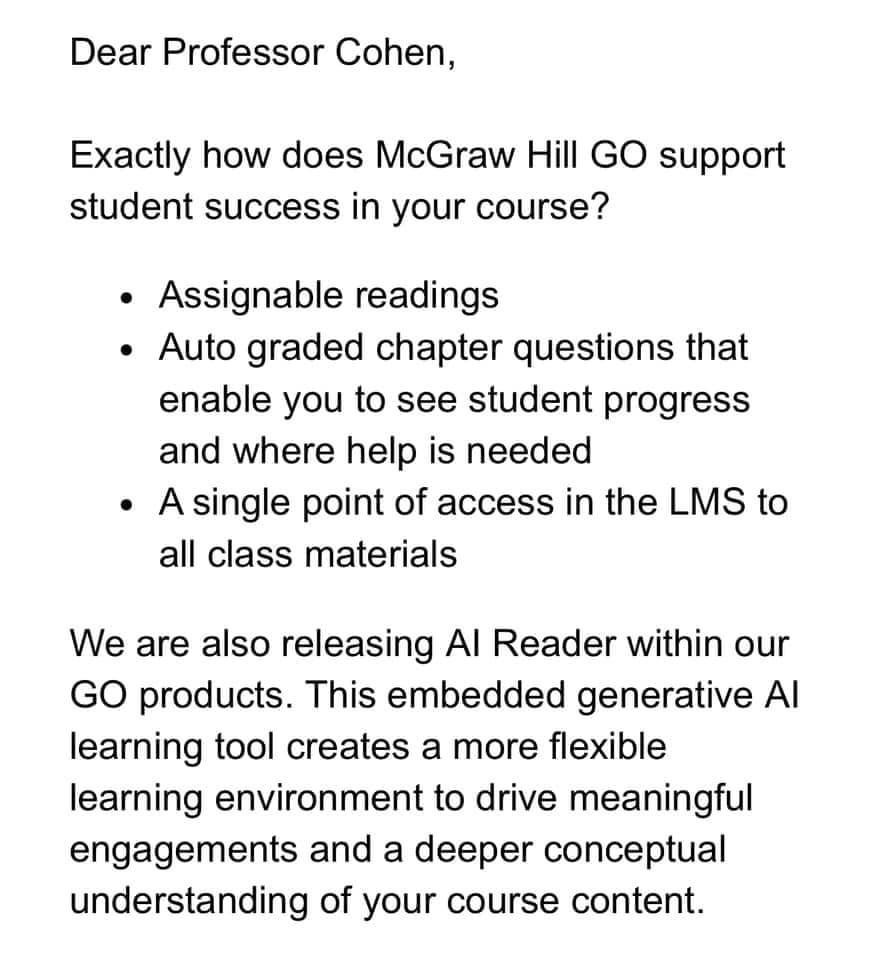
Excerpts from two emails that landed in my inbox yesterday:

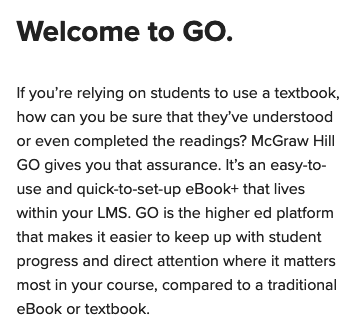
The first is from an email helpfully sent to me by McGraw Hill GO, which as the name shouts, is raring to GO to sell me a product that will help me teach, ostensibly. I mean look!

It’s an eBook+! It lives within my LMS! It makes it easier to keep up with student progress and direct attention where it matters most, which is apparently somewhere other than whether my students are learning! I guess I should be grateful for that assurance of knowing my students are completing the reading, but instead I’m checking to see if I still have my wallet. Can I drive this eBook+ off the lot right now?

It’s the AI that I should apparently be most grateful for, though. The embedded generative AI learning tool, I am told, will create a more flexible learning environment! And that environment will drive meaningful engagements! It will also drive a deeper conceptual understanding, as opposed to some other kind of understanding, of my course content! So much driving! So much cause and effect! Instead of the hard and messy work of trying to help my students understand the things they read, the world around them, and themselves and their place in it, all I have to do is sit back and let GO drive. Whew. What a relief.

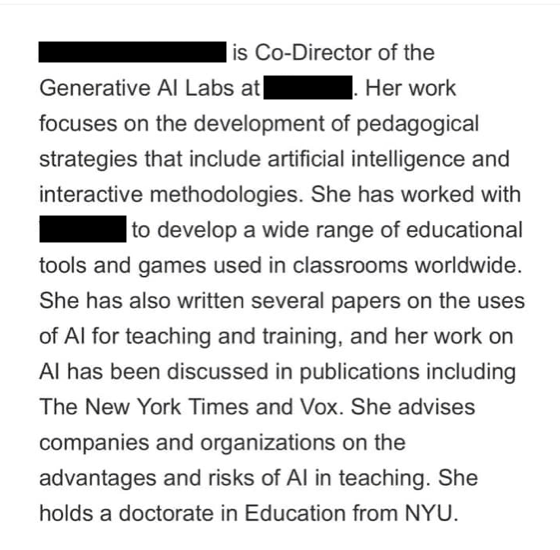
The second email comes from the Teaching for Learning (?) Center at my employer, This University in Canada, You’ve Never Heard of It. A featured speaker at an upcoming event will be the AI expert whose identity I have tried to disguise for some reason. This person will be coming to This University (TU, go fight win) to share with us the Good News of AI, sharing the εὐαγγέλιον, the gospel, that artificial intelligence has risen and will be our salvation. Do you believe in the Good News? It believes in you!

It’s the end of a long and cranky week, so forgive me the sarcasm. I’m not here to impugn motives of publishers, staff, or administrators or to criticize fellow instructors for wanting a break from the difficult work of teaching. I’m sensitive to the privilege I am lucky to enjoy of working at a research-intensive university, where, if I want, on a Friday afternoon during under-attended office hours, I can take a half hour and blog my thoughts into the abyss, and I’m sensitive to the four-four or more load of many instructors, for whom in my textbooks I have selected readings (and written apparatus supporting them) in order to lessen that load.

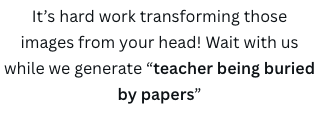
My first ever AI generated images
(prompt: “teacher being buried by papers”)

What I’m doing here with this spare half hour is saying that these claims of AI’s salvific power makes me feel like I’m being sold a bill of goods. The educational publishing company is in the business of selling things to help educators, and can hardly be faulted. It’s what it does. It has to keep swimming or it dies, or something. The whole world of ed tech (ET, by decree and henceforth) is in the same business. TU and by extension higher education are most emphatically not in the same business as EdTechpreneurs, and should not be the gullible rubes who snap up its latest products. Universities have been busy establishing a sorry track record of diving headfirst into the latest ET innovations–remember MOOCs?–and moving on from them once their promise went unrealized, leaving behind a trail littered with spent money and damaged morale.

I don’t want to overstate. I wouldn’t be so rash as to condemn everything about LMSes (how do you pluralize an acronym that ends in S? Why are my office hours today so quiet? Does it have anything to do with it being homecoming weekend?). As we learned during the pandemic, they make some things easier. But they can’t be used to replace us.

Thanks, Google™

There is considerable pressure on higher ed administrators to cut costs, and as anybody who’s looked at university finances knows, one of the only places they can cut is instructor pay and benefits. It’s why you see departments shrinking as retired tenured faculty go unreplaced; it’s why you see whole departments razed if administrators can’t wait patiently for faculty to die off or at least go away. Contingent laborers cost less. ET promises lower costs. Humanities instruction, at least, what I do, is labor intensive. Human labor intensive. Humanities departments are forever being berated for the high costs of small classes (discussions which seem never to touch on the rarely mentioned high overhead incurred by the research grants given the big-lecture-teaching faculty in other disciplines, but that’s another discussion). The value of what we do lies in helping students learn to think, creatively and critically. We want to help them learn to be able to process large amounts of complicated information, to grapple with sophisticated concepts, to know when they’re being sold a bill of goods.

Thanks, Canva™

I don’t want resource-gobbling AI to transform the images in my head. I want to do it myself because part of the reward of creative thought and expression lies in the doing of it. I want my students to learn this. I don’t want TU or any other institution of higher learning to try to save money by outsourcing the work of education; in the end it will waste both the money it spends and the opportunity for students to learn to want to come up with interpretations, solutions, expressions. I got my first AI generated assignment this week. I read it. I knew instantly where it came from, and it was confirmed by an abashed student, and it sucked. It didn’t know anything, and it didn’t think anything, and it didn’t express anything.

My office hours are over. Monday morning I’ll come back to campus. At noon, my students and I will discuss the upsetting ending of Toni Morrison’s upsetting and beautiful novel The Bluest Eye, and we will talk about the history of it being banned around the country and in the town some of them come from by people who don’t value the kind of education that involves reading upsetting and beautiful things, and we will probably also talk about homecoming weekend and think about what universities are for, which I am always trying to get them to do because the whole point is to get them to look around and think about where they are, whether “there” is their classroom or university or state or country or planet. (They will also get good paying jobs because they know how to read and think and express their thoughts but can we please not let that be the only reason we do this?) I will try to drive meaningful engagements, if you want to put it that way, and appreciate the opportunity I have been given to do this important work the way I think most effective. Also I use much less water.