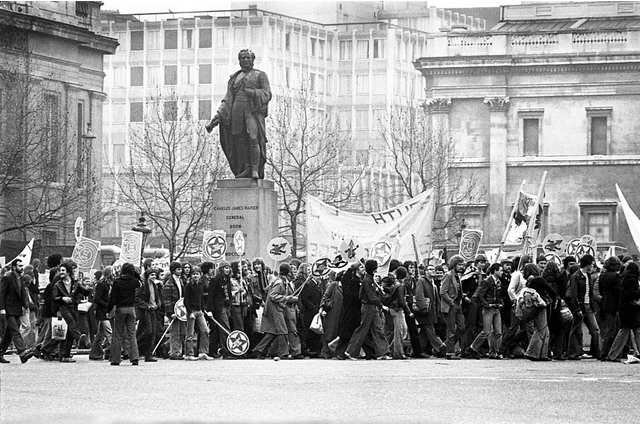
In April 1978, at the Rock Against Racism concert in Victoria Park, The Clash played their song “English Civil War” live for the first time. The organization Rock Against Racism, formed in 1976 in reaction to racist incidents and the rise of the National Front in the UK as well as to racist statements by Eric Clapton and David Bowie, staged two national carnivals in 1978, the first in Victoria Park in East London, where The Clash played with Steel Pulse, a reggae band from Birmingham, and a few other punk bands.
“English Civil War” is set to the tune of “When Johnny Comes Marching Home,” the American Civil War ballad, and also borrows its first line. The song uses this inspiration to imagine the war it fears is, as Joe Strummer said in an interview shortly after the song’s first performance, “right around the corner.” I thought of the song yesterday, after watching clips from Trump’s Madison Square Garden rally the night before, and played it couple of times. I’m playing it right now.
The line that made me think of this song yesterday: “Your face was blue in the light of the screen/As we watched the speech of an animal scream.” As has been the case for nine years, I’m angry at Trump and his mob’s racist, hateful rhetoric almost as much as I am at what he’s done in office, at what he’s inspired in others in other offices, and at what he threatens to do if he gets into the White House again. I’m angry at this rhetoric not only because of the immediate effects on its objects and the potential acts of violence it can inspire but because of the long-term effects on us. Our faces are lit by our screens a thousand times more than they were in 1978, everywhere we go, walking and driving and laying in bed; these days, we get to hear animal screams like we heard a couple of nights ago everywhere and all the time. If you’re the immediate object of the hatred, of the racist attacks on your intelligence and humanity, the hurt must go very deep. If you’re not but don’t agree with what they yell and don’t want to live in a world where it’s okay to yell those things, that’s another kind of hurt, also profound. But what if you don’t know to be hurt, don’t know that it’s not okay to yell those things? What if you’ve grown up in the last nine years hearing them? What if you’ve seen people cheering them on and repeating them?
What I didn’t remember until I listened again to “English Civil War” is how the song ends:
When Johnny comes marching home again
Nobody understands it can happen again
The sun is shining and the kids are shouting loud
But you gotta know it’s shining through a crack in the cloud
And the shadows keep on falling when Johnny comes marching home
The balancing of hope and fear in these lines capture what all the young punks (to quote a different song) involved in Rock Against Racism must have been feeling almost fifty years ago as they heard the boots of the National Front crunching around the corner and the spittle-flecked slurs fly from Eric Clapton’s lips. They hoped that calling it all out, together, shouting loud, would have some effect, but at the same time they feared that it wouldn’t be enough, that the sun squeezing through the crack in the clouds would lose out to the falling, looming shadows. That it could happen again.
Fifty years later and a week out from election day, millions of Americans know the feeling. But millions of us don’t–they’re cheering on the animal scream. And fifty years from now, the kids whose faces were blue from the light of the screens showing them these rallies, these speeches, this hate: what about them?
& & &
“English Civil War” was released as a single in February 1979. The b-side was a cover of the Toots and the Maytals song, “Pressure Drop.” The Clash had already covered a Junior Murvin song, “Police and Thieves,” on their first album, demonstrating their affinity for reggae music and for its incorporation of political sentiment (though it may not have always been appreciated– Murvin’s initial response to the cover was reportedly “They have destroyed Jah work!”). Toots Hibbert has said that “Pressure Drop” is a song about karma, about bad things happening to people who do bad things to innocent people–“pressure’s going to drop on you”–and that he wrote it after he had been innocently imprisoned. It may be a revenge song, but it’s not about violence, at least not explicitly; instead, it’s about the knowledge coming to the malefactor–“I say when it drops, oh you gonna feel it/Know that you were doing wrong.”
So I’ll end my early evening in the office listening to this song instead. It’s not a happy song, exactly, though it’s less unhappy than “English Civil War.” But the hope that people doing wrong will know that they were doing it, someday–or at least and maybe even better, that the millions watching will know, someday, that what they heard those people saying and saw them doing were wrong–is not nothing.
 Samuel Cohen